

Patagonia Didn’t Grow by Wanting More; It Grew by Wanting Less
Updated: Feb 9
Why restraint, values and saying, "No" became Patagonia’s greatest growth strategy.

There’s a popular narrative around Patagonia.
Anti-corporate.
Anti-growth.
Anti-consumerism.
But the truth is more disciplined. And more strategic.
Patagonia didn’t reject growth.
It redefined it.
Values Are Easy to Say. Hard to Operate.
Many brands talk about values.
Patagonia built systems around them.
Under founder Yvon Chouinard, the company made decisions that actively limited short-term upside:
Repairing products instead of pushing replacements
Encouraging customers not to buy
Committing to environmental accountability, even when inconvenient
These weren’t marketing campaigns.
They were operational choices.
The Strategic Trade-Off
Patagonia understood something counterintuitive:
Restraint builds trust. Trust builds longevity.
By consistently aligning action with values, Patagonia:
Created credibility that couldn’t be copied
Built a fiercely loyal customer base
Differentiated in a crowded, commoditized category
Values weren’t decoration.
They were infrastructure.
Why This Works (and Often Fails Elsewhere)
Many brands try to borrow Patagonia’s language without adopting its discipline.
That’s where it breaks.
Because values only work when they:
Cost you something
Shape real decisions
Hold up under pressure
Anything else is branding theater.
The Real Patagonia Lesson
Patagonia didn’t grow by being louder.
It grew by being consistent.
That consistency became a competitive advantage.
One that compounded over time.
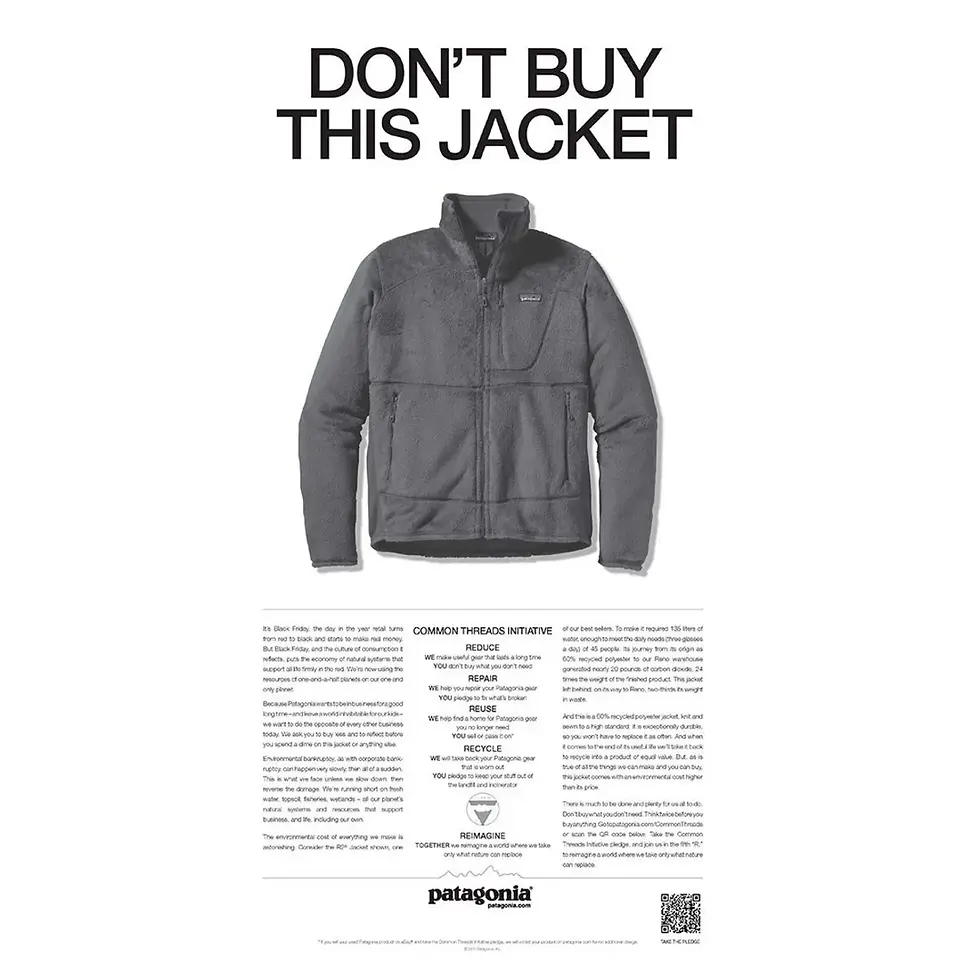
The Patagonia Story That Makes the Brand Unforgettable: “Don’t Buy This Jacket.”
In 2011, on Black Friday, Patagonia ran a full-page ad in The New York Times with a photo of one of its jackets.
The headline:
DON’T BUY THIS JACKET
The ad explained the environmental cost of making the product (water use, carbon emissions, waste) and urged people to buy only what they truly needed.
Sales went up.
But that wasn’t the point.
The ad didn’t confuse customers because Patagonia had already trained them to expect integrity.
That’s why it’s still talked about today.
The Moment That Sealed the Brand’s Legacy
Yvon Chouinard Gave Away the Company
In 2022, founder Yvon Chouinard transferred ownership of Patagonia (valued at ~$3 billion) to a trust and nonprofit structure so profits would go toward fighting climate change.
Not selling.
Not IPO-ing.
Not licensing values.
Giving control away.
Permanently.
That decision didn’t just say what Patagonia stands for.
It made it irreversible.
Final Thought
Not every brand should be Patagonia.
But every brand should decide:
What it will protect
What it will refuse
What it will never compromise
That’s not ideology.
That’s strategy.
Brand stories minus the mythology, plus the strategy.
Art & Copy Group


Comments